[ad_1]
Over the previous 4 many years of nationwide renewal, tourism in An Giang has undergone a robust transformation, steadily asserting itself as a spearhead financial sector. The trade has contributed to financial restructuring, job creation and improved residing requirements, whereas serving as an efficient channel for selling the province’s cultural identification to the world.
Vacationers go to and expertise the Hòn Thơm cable automobile in Phú Quốc. VNA/VNS Photograph
AN GIANG — Following administrative consolidation, An Giang has emerged with a renewed growth area and a particular tourism panorama stretching from the legendary Seven Mountains to offshore islands, positioning itself as a rising spotlight on Việt Nam’s tourism map.
Over the previous 4 many years of nationwide renewal, tourism in An Giang has undergone a robust transformation, steadily asserting itself as a spearhead financial sector. The trade has contributed to financial restructuring, job creation and improved residing requirements, whereas serving as an efficient channel for selling the province’s cultural identification to the world.
With a pure space of practically 10,000 sq. kilometres, An Giang possesses a uncommon mixture of plains, mountains, borderlands, rivers and sea. This variety permits the province to develop a variety of tourism merchandise, from non secular and cultural tourism to eco-tourism, agricultural tourism and island-based resort tourism, making An Giang a particular vacation spot within the Mekong Delta.
The province is dwelling to a collection of well-known locations equivalent to Phú Quốc, a centre for high-quality eco-tourism and international-standard island tourism; Hà Tiên-Kiên Lương-Kiên Hải, identified for cultural heritage, historic relics and marine ecology; the Vĩnh Tế-Mount Cấm space, thought to be a stronghold of non secular tourism within the Seven Mountains area; in addition to wealthy forest ecosystems together with U Minh Thượng Nationwide Park, Phú Quốc Nationwide Park and Trà Sư cajuput forest.
Along with pure property, An Giang’s cultural richness, formed by the long-standing coexistence of Kinh, Hoa, Khmer and Chăm communities, is a key aggressive benefit. This cultural convergence is mirrored in festivals, structure, beliefs, delicacies and day by day life, forming a particular identification that underpins the sustainable growth of the native tourism trade.
Based on the An Giang Division of Tourism, the province welcomed greater than 80.8 million guests between 2021 and 2025, together with practically 3.5 million worldwide arrivals, producing whole tourism income of over VNĐ142.8 trillion.
In 2025 alone, tourism income reached practically VNĐ68 trillion, up 92 per cent yr on yr, whereas whole customer numbers exceeded 24.1 million, a rise of 27.3 per cent. Worldwide arrivals rose sharply to greater than 1.9 million, up over 90 per cent in comparison with 2024, highlighting a robust restoration and robust progress momentum.
These figures spotlight tourism’s position as a key progress driver, contributing to financial restructuring, job creation and improved residing requirements, whereas serving as an efficient channel for selling An Giang’s picture and cultural identification to the world.
Karolina Agnieszka, a Polish nationwide and the 20 millionth worldwide customer to Việt Nam in 2025, was given a ceremonial welcome at Phú Quốc Worldwide Airport. She stated she felt lucky to be in Việt Nam, praising the nation’s magnificence and the friendliness of its folks, and added that she would advocate the vacation spot, particularly Phú Quốc, to her family and friends in Poland.
An Giang can be among the many nation’s main localities in attracting tourism funding, with 317 tasks and whole registered capital of greater than VNĐ402 trillion. Main developments in Châu Đốc, Tri Tôn, Tịnh Biên, Phú Quốc, Hà Tiên, Rạch Giá, U Minh Thượng, Hòn Tre and Hòn Sơn have helped form a diversified, interconnected tourism ecosystem, combining non secular and cultural tourism, eco- and agri-tourism, island resorts and concrete companies, thereby enhancing regional competitiveness.
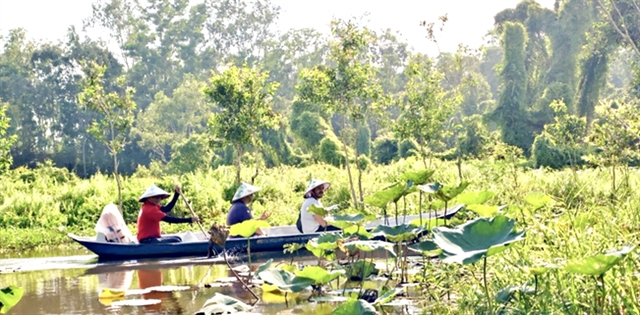
Worldwide vacationers go to the Trà Sư cajuput forest. VNA/VNS Photograph
Inside this broader panorama, Phú Quốc stands out as a defining image of transformation. From a little-known island district, Phú Quốc has risen to change into Việt Nam’s “tourism capital”.
Its official recognition as a Grade-I metropolis in March 2025 marked a historic milestone, reflecting its rising nationwide and worldwide stature. The growth of worldwide air connections, seaports, street networks and energy infrastructure has laid a strong basis for speedy tourism progress.
Massive-scale investments by main companies have reshaped the island into a contemporary tourism hub with built-in resort, leisure and concrete complexes. Phú Quốc has repeatedly appeared in worldwide rankings of Asia’s most tasty locations and has been chosen to host the 2027 APEC Financial Leaders’ Assembly, additional affirming its international enchantment.
Past infrastructure and branding, tourism growth has additionally reworked native livelihoods. Many fishing communities have diversified into tourism-related companies equivalent to homestays, eating and experiential excursions, combining conventional occupations with new financial alternatives.
Constructing on these achievements, An Giang has set formidable targets for the approaching years. By 2030, the province goals to welcome 39.5 million guests, together with greater than three million worldwide arrivals, and generate tourism income of VNĐ108.45 trillion. The objective is to determine An Giang as a robust tourism model at each nationwide and worldwide ranges, and as a key gateway within the regional “customer financial system”.
To realize this imaginative and prescient, the province has recognized priorities together with enhancing transport connectivity, diversifying high-end tourism merchandise, accelerating digital transformation, enhancing human useful resource high quality and strengthening regional and worldwide linkages. Coverage proposals additionally embody extending visa exemptions for key worldwide markets and lengthening visa-free stays for overseas guests to Phú Quốc.
With its newly built-in geography, wealthy pure and cultural assets and a transparent growth roadmap, An Giang is positioning itself as a inexperienced, sustainable and internationally aggressive tourism vacation spot. The province’s journey displays not solely financial ambition but in addition a dedication to sharing native values and identification with the worldwide group. VNS
[ad_2]